Monday, February 12, 2007

Strange statues around the world


  1. Frogner Park, Oslo, Norway (thanks Stenar, jac). Sculpture by Gustav Vigeland.
    1 - oslo, norway.jpg

  2. Stockholm, Salzburg; Sweden (thanks Johannes, David, Mogens Beltoft, Yuriy Korzhkov)
    1 - sweden.jpg 2 - sweden.jpg3 -sweden.jpg4 - sweden.jpg

  3. Prague (thanks Michael, Matt Simpson)
    1 - czech 2 -czech

  4. Statue of german writer Kafka, Prague, Czech (thanks Jon Elbert)

  5. Brussels, Belgium (thanks jamyleloup)
    belgium 1

  6. The man who measures the clouds by Jan Fabre, Belgium (thanks David Felizarda)

  7. By Damien Hirst. 5th Ave., Manhattan, US (thanks Chris Coleman, nelis)
    90.jpg

  8. Salt Lake City, Utah, US (thanks Stenar)
    39.jpg

  9. Fremont Troll of Seattle, WA, US (thanks vanjulio)
    126.jpg

  10. Turin, Italy (thanks texilee)
    81.jpg

  11. Bratislava, Slovakia (thanks Daniele)
    3.jpg 12.jpg

  12. “The Illuminated Crowd”, in front of the Banque Nationale de Paris tower, Montreal, Canada (thanks SNF)
    26.jpg

  13. Melbourne, Australia (thanks catenoid)
    13.jpg73.jpg 77.jpg

  14. Minsk, Belarus (thanks Aleh)
    24.jpg 66.jpg

  15. In front of the Ernst & Young building, Los Angeles, US (thanks Pam)
    43.jpg

  16. Toronto, Canada (thanks Kristan)
    129.jpg

  17. Mazinger Z, Spain (thanks mpc, Ten, Mat)

  18. Atocha RailStation, Madrid, Spain (thanks guimi)
    55.jpg

  19. Optimus Prime, China (thanks Juan Incognito)

  20. Malmo, Sweden (thanks kip, dragonsden)
    9.jpg

  21. UOB Plaza, Singapore. Address: 80 Raffles Place. (thanks Juhu)
    85.jpg

  22. La Pouce, Paris, France (thanks Jeff, Marc Lacoste)
    137.jpg

  23. Depiction of a bread line, Franklin Delano Roosevelt Memorial, Washington, DC, USA (thanks JohnK3)
    34.jpg

  24. Berlin, Germany (Lou)
    64.jpg

  25. Russia (thanks littlebat)
    107.jpg 134.jpg119.jpg

  26. Cheltenham, UK (thanks Tim)
    72.jpg

  27. Millesgеrden, Stockholm, Sweden. By Carl Milles (thanks Twee)
    65.jpg

  28. Yerevan, Armenia (thanks Hayk)
    98.jpg 111.jpg118.jpg

  29. Oxford, UK (thanks CdrJameson)

  30. “Tête au carré” building by Sosno, Nice, France (thanks gimix)
    41.jpg

  31. Singapore (thanks Misayo)
    42.jpg

  32. Amsterdam, Holland (thanks Korilian)

  33. Asus headquarter, Taiwan (thanks Phil). It is made from computer chips
    48.jpg

  34. Kiev, Ukraine (thanks Eugene). It commemorates a local comedy actor truly beloved by public - he liked to sit at that very place with his old dog.
    96.jpg

  35. Nuremberg, Germany (thanks Nick, Armin)
    37.jpg

  36. Bremen, Germany (thanks morlach01)
    40.jpg

  37. Trafalgar Square, London (thanks sam_m, MJ, Simon C). A sculpture of Alison Lapper by Marc Quinn
    83.jpg

  38. Kharkov, Ukraine (thanks PHWizard)
    74.jpg

  39. Monaco (thanks NK)
    125.jpg

  40. Cologne, Germany (thanks Alexandre)

  41. In front of The Institute for Microbiology, Tuebingen University, Germany

  42. Statue of a tourist, Shanghai, China (thanks Jakob)

  43. near San Giovanni train station, Como, Italy (thanks Dario)
    80.jpg

  44. Wateringen, Holland (thanks FBS, Roadie)
    116.jpg

  45. Potsdam, Germany (thanks Ola)
    106.jpg

  46. Santa Fe, New Mexico (thanks Gatrh, Paul)
    103.jpg

  47. Springfield, Missouri, US (thanks Noella)
    35.jpg


Around the world

  1. 113.jpg

  2. 120.jpg

  3. 133.jpg

  4. 135.jpg

  5. 18.jpg

  6. 19.jpg

  7. 2.jpg

  8. 21.jpg

  9. 32.jpg

  10. 33.jpg

  11. 36.jpg

  12. 38.jpg

  13. 45.jpg

  14. 49.jpg

  15. 52.jpg

  16. 54.jpg

  17. 62.jpg

  18. 63.jpg

  19. 69.jpg

  20. 70.jpg

  21. 76.jpg

  22. 6.jpg

  23. 7.jpg

  24. 8.jpg

  25. 82.jpg

  26. 84.jpg

  27. 86.jpg

  28. 87.jpg

  29. 95.jpg

  30. 97.jpg


Also check out our selected content at haha.nu

Kensington Notebook Firewall

Written by Jay This little piece of equipment made its way onto my stores shelves the other day, made by Kensington, the “Personal Firewall for Notebooks” resembles a USB key in every way shape and form. So how does it protect in “all wireless environments”? Is it a wireless card as well? If so does it have flashdrive capabilities built in? Lets check it out...

Device in its Packaging


Kensington claims this device :

Detects and protects against hackers in all wireless environments--even outside corporate firewalls.

Hides your identity from the Internet.
Safeguards important data stored on your notebook.

Simply plug the key into your notebook to activate the firewall; remove the key to disable.
Protection will not interfere with corporate firewall and anti-virus software.

Installation

Upon putting it my USB port, it detected that I was running other firewall software that conflicts with the device, so that was the answer to how it protects (although it seemed a bit obvious), it runs a software firewall. After not just disabling, but having to uninstall my Sygate Personal Firewall, the device (and software) finally installed itself.

One thing I found interesting during the installation, Windows detected the device not only as a USB mass storage device, but it also detected as a CD-Rom drive. This makes it so the program files are untouchable, they can not be deleted, modified or re written, and the drive auto runs the same as if you were inserting a CD. Good idea. The device shows up in My Computer as both a removable disk and a CD Rom. The real disappointing part is that the total combined size of the drive is under 12 MB, with only 5 of that writable. The directory it creates in the Program Files folder is relatively tiny to begin with, just over 500Kb.

The Firewall Interface

There’s honestly not a huge amount to say here, it is an overall user friendly interface, but as with most software firewalls, if you’ve seen one you’ve seen them all. There are slider bars for levels of security, ranging from high to low to custom, for both internet and network settings, with profiles for both home and office. Overall the firewall is a nice little piece of software with quite a few of the more common options. The one nice thing I see about the software is the profiles for both home and office.

Conclusion

Overall I think the device can be easily (and freely) replaced by Sygate or Tiny Firewall. The space to store things on the flash drive is a nice added touch, but with only 5 MB, you can’t store all that much. It would be nice to see a 256 MB or 512 MB version of this released, possibly with portable Firefox and Open Office preinstalled, for a complete portable security solution. The device truly isn’t for locked down company computers as it claims to be, as it does create a directory in the C: drive to store its preferences in during the installation process.

Final Thoughts

Buy a months supply of Tim Hortons Coffee with the money you’d spend on this. The time it would take for you to walk to your IT department to have them install the program (or for you to do it yourself on your personal computer), install Sygate Personal or Tiny Firewall instead and spent the $60 CAD a better way. That way there’s no USB key to loose.

Saturday, February 10, 2007

Stand-alone controller runs Linux


United Electronic Industries has introduced the UEIPAC line of programmable automation controllers. These stand-alone modules contain an embedded computer running a standard Linux operating system, two Ethernet ports, a serial port, an SD card interface, an inter-PAC sync interface, and either three or six I/O card slots.

I/O boards add up to 150 analog inputs and 288 digital I/O channels. Other I/O boards add analog outputs, counter/timer channels, quadrature encoders, serial ports, CAN bus ports, and ARINC-429 interfaces. You can write your application on a PC and download it to the controller, which can then operate as a stand-alone unit. The modules operate in harsh environments from –40°C to +85°C, at 5g vibration, 50g shock, and up to 70,000 ft in altitude (for aerospace testing).

Prices: UEIPAC 300 (3 I/O board slots)—$1495; UEIPAC 600 (6 I/O boardslots)—$1795. United Electronic Industries, www.ueidaq.com/PAC.

The People of the Waters


People inhabit the most different regions of the Earth, from seashore to over 4,000 m (12,000 feet) altitude and deserts where temperatures overpass 50 degrees C or polar zones.

Not only the ground, but water too serves, since the oldest times, for some human populations as natural environment, in which they organize a specific life.

But why water?

Because the great water surfaces, with their inexhaustible vegetable and animal richness, allow a relatively easy food and clothing procurement, being at the same time facile paths of connection with the outside world.

Aquatic settlements also represent natural fortresses which defend their inhabitants against the attack of wild beasts or enemy tribes.

That’s why some populations keep on building houses on water.

Let’s know some of the palustrine populations.

In northeastern India, on the Valley of Brahmaputra River, amongst other peoples, live the Garos.

Their houses are inside the wet jungle, surrounded by hills.

Before the beginning of the monsoon (from June to October, bringing huge amounts of rainfall that floods large areas), the Garo people, which live during the dry season in bamboo


huts, move in “suspended” houses.

The walls, the floor and the ceiling of these houses are made of bamboo.

Even if for securing the wood, Garo people do not use nails, their houses are solidly installed on their pylons.

Garo people also use pre-built materials: the walls and the floor are interlaced before, during the building process they are just bonded with bamboo bindings.

Once, Garo people were headhunters.

In the center of Cambodia is the Tonle Sap Lake, which trough the Tonle Sap River is connected to Mekong River, the biggest in Southeast Asia.

During the rainy season (May to October), the lake increases its surface six times (from 2700 to 16,000 square km-1000 to 6000 square miles), and the average depths from 1 m to 9 m.

This lake has a great fishing importance.

Fishermen around the lake have houses built on rafts (photo 1,2), secured by stilts implanted on the bottom of the lake.

The floor can be moved up and down on these stakes, depending on the level of the waters.

Kennels and coops and even kitchen gardens can be seen on the rafts attached to the main house with bamboo ropes.

When the waters retreat, the houses and the coops are left on the ground.

In the capital of the Sultanate of Brunei (northeastern Borneo), named Bandar Seri Begawan, there is a district called Kampong Ayer (“Water Village”) (photo 3), built on the water and compassing about 30,000 inhabitants (10 % of the country’s population).

The houses are gathered and connected by narrow decks.

To enter a house, a staircase like those for a chicken coop is used.

The housings are simple, but very neat.

Between the planks of the floor are spaces so large that the water below can be seen.

Some say that these housings were build up for sanitary reasons, others that as defense but what’s definitely clear is that the air over water is cooler than the hot one over the ground, of 35-38degrees C all year round and with not a breeze (the so called equatorial calm).

In front of the houses there are built platforms.

That in the front of the school is big enough to serve as schoolyard.

On the Luzon Island, the biggest in Philippines, live the Tagalog (“those near the river”) people, named so because of their habit of establishing themselves near waters.

Some of the tagalogs live in small boats named “kasko”.

They migrate from place to place in their small vessels.

These people do not practice agriculture and live from sea resources.

On the Andes High Plateau called Altiplano, at the border between Peru and Bolivia, the Lake Titicaca is situated.

This is the largest high altitude lake (8,372 square km) and the navigable lake situated at the greatest altitude (3,812 m).

Amongst the inhabitants of the region are the Uros people, who found in other times refuge from Inca in the center of the lake.

They inhabit artificial islands (photo 4) called totorals on the Titicaca Lake.

The islands are made from floating rafts made by totora, a type of reed that grows abundantly at the lake’s shore.
These islands can last to 30 years, harboring up to 10 families.

Totora is also used for making mats, ceilings, and so on, but also serves as forage.

For traveling around the lake, the Uros use totora boats, with high extremities and made of long totora sheaves, tightly secured with vegetable ropes that make a perfect tightness.

In the center of Amazonia region lies the city of Manaus, inhabited by almost 2 million people.

Here, the temperatures are almost the same all year round only that the winter is rainy and the waters swell.

During the rains, many floating houses (photo 5) of the indigenous people, made of cashew brown-red wood, glossy and very resistant, are ripped off from their anchors and dragged in other places.

None is scared by this sudden removal, and when the rainy season ceases, the inhabitants restart their occupations, like nothing would have happened.

Take Full Control of Your Computer

1st Security Center Pro by SSS Lab Inc

Version reviewed: 5.0.2.1

1st Security Center Pro is a security software that protects your PC.

Some features:

You can deny access to each individual component of several Control Panel applets, including Display, Network, Passwords, Printers, and System
Disable your boot keys, DOS programs, Registry editing and network access.
User Working Time option
Administrator password
Folder protection

DOWNLOAD PROGRAM
We all know how important is to protect our computer and the data we store. For online attacks there is a myriad of antivirus, firewall and anti spyware softwares to choose from. But you should also take care of the inside attacks which are more or less intended. Having a software that can lock some features in Windows is always good news.

You can never know what your kid, wife or brother is doing on your computer and there is always the risk that their “computer talents” are limited to playing some games, listening to music and watching a movie once in a while. In one word, unskilled computer users can damage your settings and create problems.

1st Security Center Pro allows locking your system, network and remote access settings so that you prevent the other users of the computer from changing the way your computer works. The $24.95 solution from SSS Lab Inc sports a feature uncommon among similar softwares. It allows the administrator to set up a time interval and a duration of a user's working time.

The interface can be changed due to the 37 skins the application is equipped with. Some of them are like salt in the eyes like Fallout Style, while others are just perfect for your needs (like Elegant). But after all it is just a matter of taste for choosing the right one.

The WYSIWYG looks make it easy to use and recommend it for newbies. Taking into consideration the options made available one can say that 1st Security Center Pro covers a vast area of your computer's options and settings.

The tree in the left displays the areas of your computer that can be configured. But before deciding to impose any restrictions you should apply a password for launching the software. This way you will be sure that only authorized persons will tamper with your settings. The two general areas available are Windows Common Restrictions and Users Restrictions.

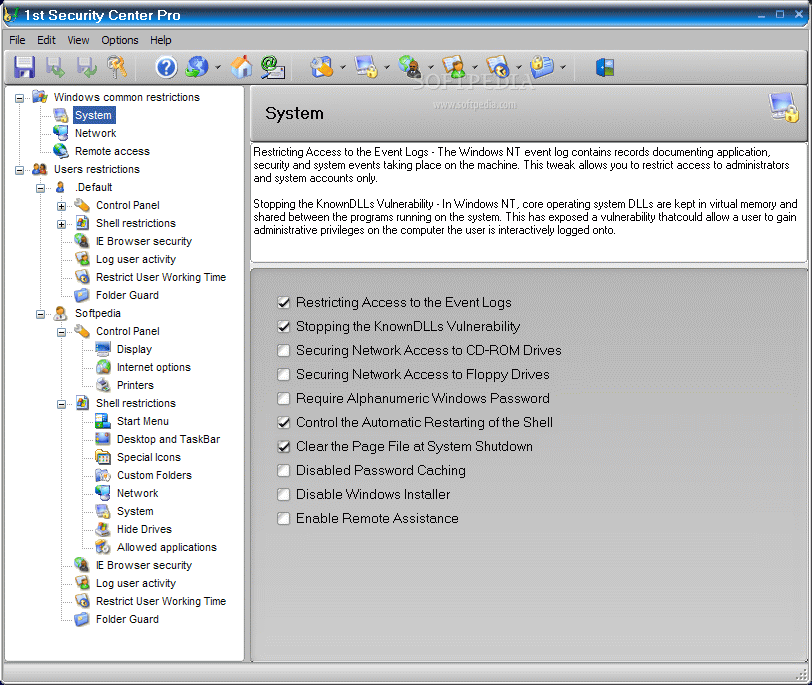
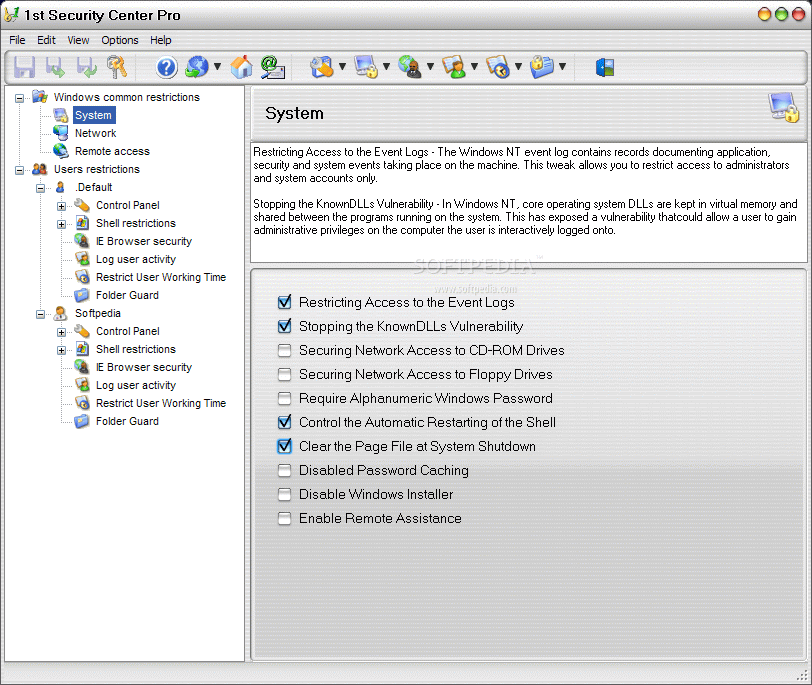
The first section includes configuring System, Network and Remote Access. The tips displayed for every section provide a brief description of the options available. System settings deal with restricting access to event logs, secure network access of CD-ROM drives, disabling the password caching, or enabling remote assistance.

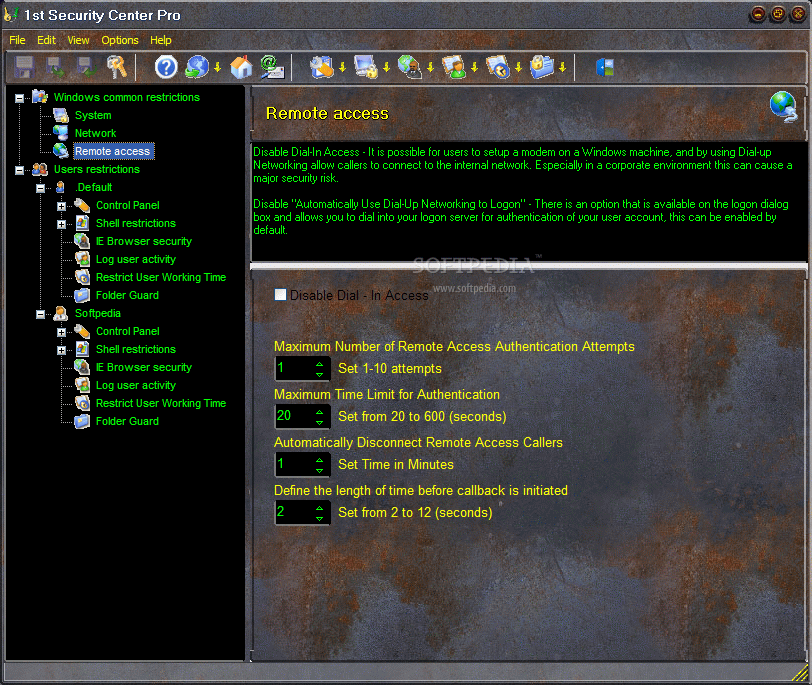
Configuring the Network allows enabling and disabling a series of network related options like disabling file sharing, hiding share passwords with asterisks, hiding servers from the browser list or allow fast user switching. The options for Windows common restrictions do not stop here and the user can make the necessary configuration for the Remote Access. In this concern the number of remote access authentication attempts can be set as well as the maximum duration for remote access callers to stay connected or defining the length of time before callback is initiated.

User Restrictions is the area that provides the most variate option. The subfolders include all the users that have an account created on your computer. For each of them you can impose a number of limitations regarding the use of the Control Panel and Windows shell.

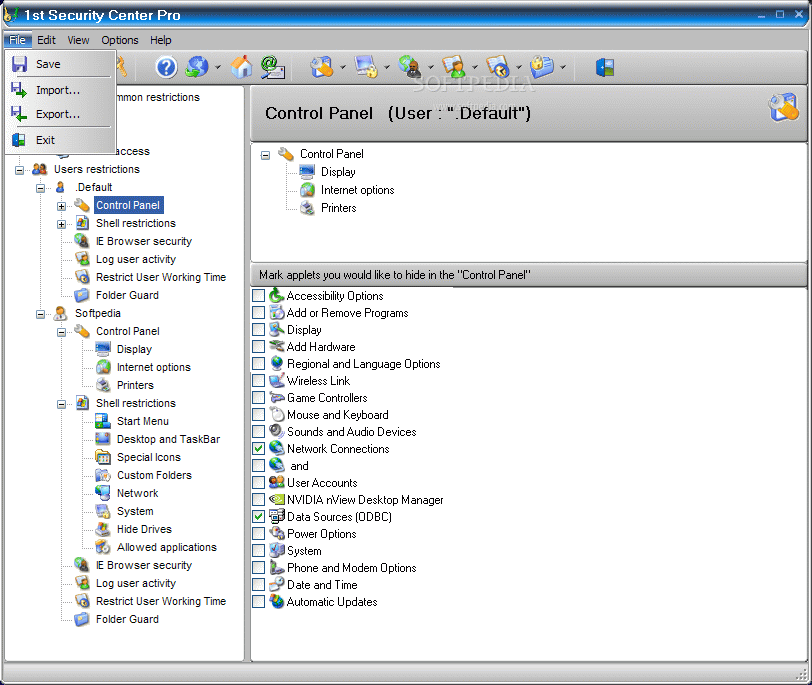
Control Panel restrictions include Display (disabling the applet, hiding the background page, the settings and appearance page), Internet Options (disabling the General/Security/Content/Connections/ Programs and Advanced tabs in Internet Options) and Printers (disabling addition/deletion of printers and hiding the General and Details pages). All this options can secure you against other peple's messing around with your general settings.

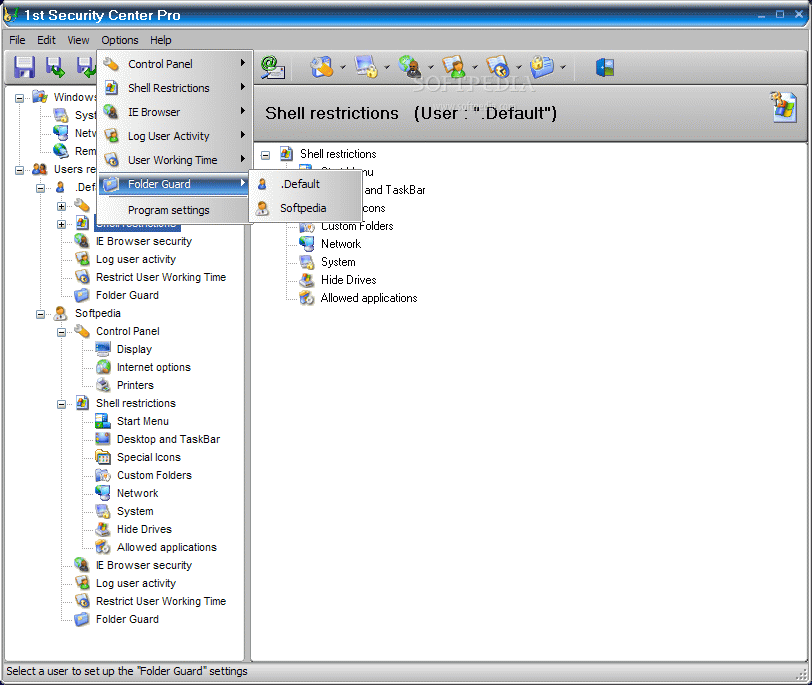
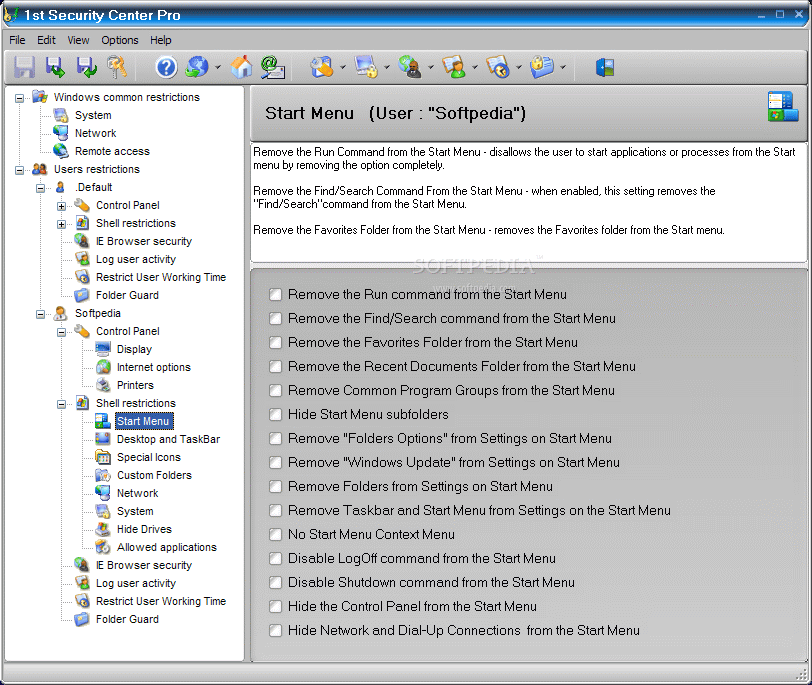
Shell restrictions area is the one where you should definitely take a look as there are some options that deserve special attention and can come in very handy. The suite of limitations available in the Start Menu solder comprise removing Run command from the Start Menu or disabling “Log Off” command. To be frank none of these options available in here worked in my case. I can't explain what happened because Start Menu restrictions were the only ones that did not function properly, even with numerous restarts of the machine.

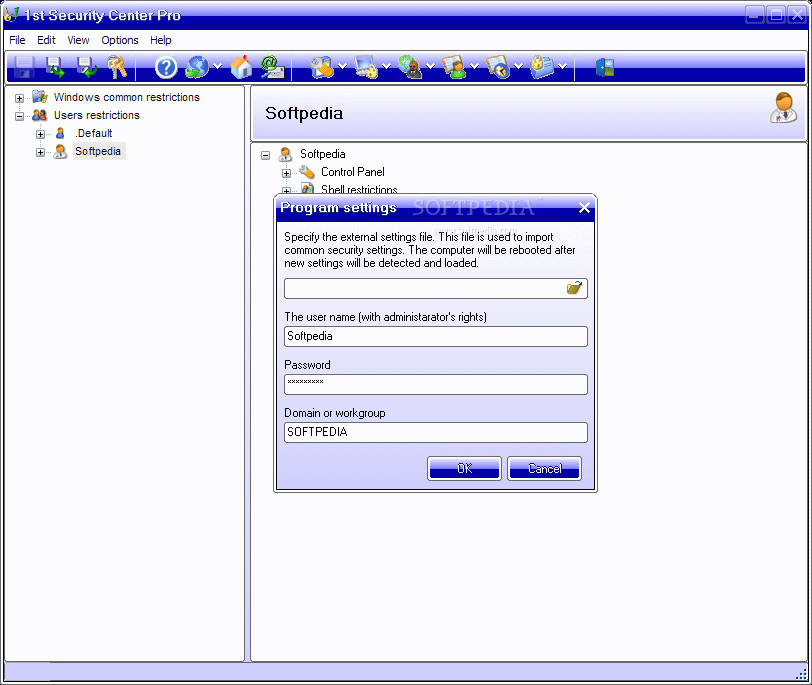
The last of the pictures shown below will stand as proof (as you can see the user is Softpedia both on my computer and in 1st Security Center, and the “Save” button activated; and yet the Run command is still available on my computer). On the other hand, the application had no problem with hiding the requested


icons (My Computer and Recycle Bin) from the desktop and bringing them back.

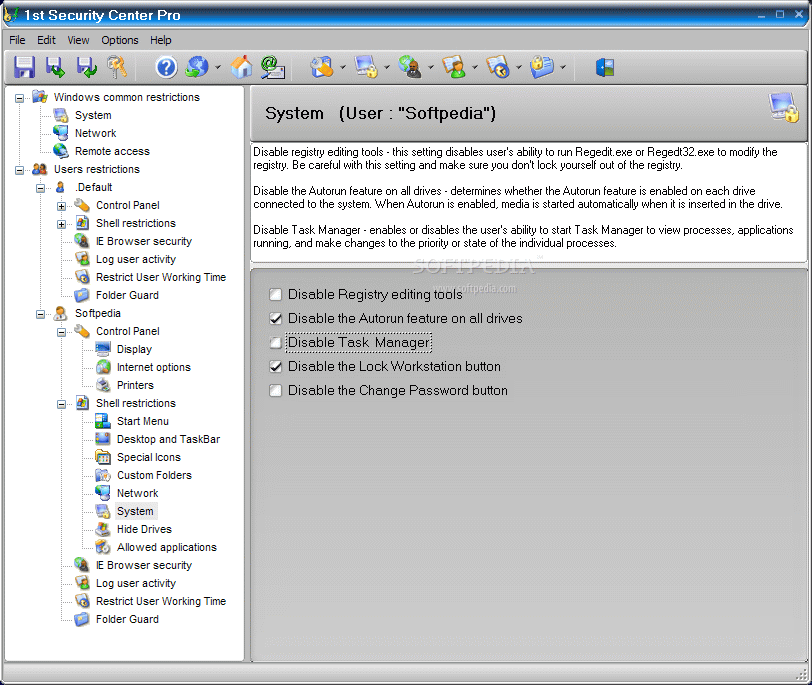
System settings in Shell Restrictions provides an easy way to disable the registry editing tools (this option really works), the task manager (also works) and the Autorun feature on all drives (works as well). When it comes to hiding drives, things partially work as the drives will indeed be hidden and Windows Explorer will indeed no longer display them, but working with the hidden volume in any other file manager is possible.

I am sure that you would like to decide which applications could one of your computers use and which not. Your wish comes true with 1st Security Center Pro as it sports the Allowed Applications option which lets the administrator of the program create a list with the softwares that a certain user should be able to open. During our testing the feature worked fine, but restarting the machine was necessary in order for the changes to take effect. However, there were some problems with the keyboard drivers as they were not on the list and after the display of the message announcing that using that application is restricted by the administrator, the favorite keys assigning dialog appeared.

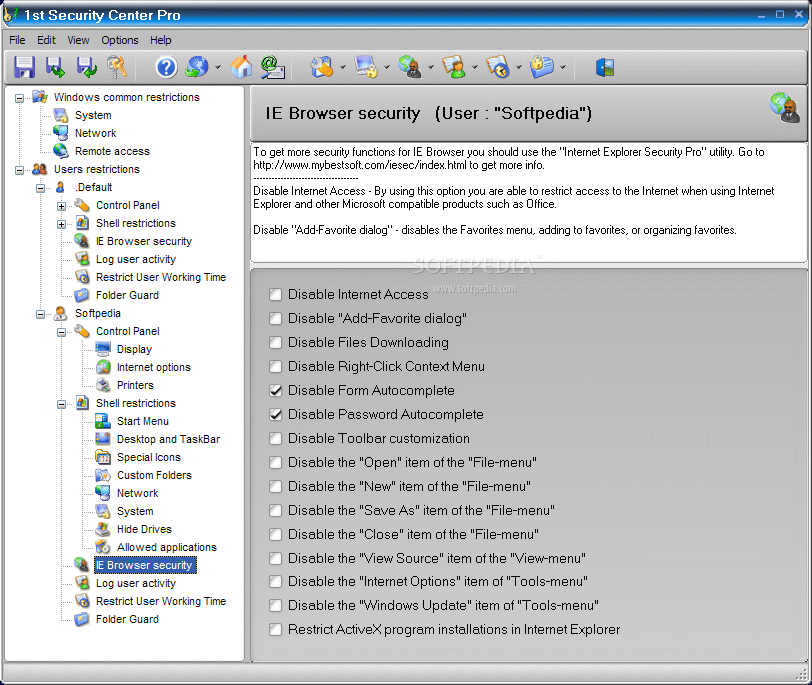
If you are an IE user, then there is a number of restrictions for this application to be applied too. You can disable the Internet access, the downloading of the files (once the first option is enabled all the rest involving Internet browsing are futile). Be careful with disabling the “Close” item in “File menu” as in Internet Explorer 7 there is no such option (well, there is “Exit”) and you will no longer be able to exit the application by using the Exit option or the “Close” button in the topmost right corner. In this case IE 7 can be shut down by killing its process in Task Manager.

Logging user activity option is available, but unfortunately during the testing all there was recorded was the name of the user and the time and date of the login on the computer. This would have been a very good option for checking out where the others are hanging on the Internet in your absence (sounds like a keylogger, doesn't it?).

Finally, my favorite features are at the end of the restrictions list. These are Restrict User Working Time and Folder Guard. The first one is particularly interesting as you can set up an interval and duration of an user's working time.

If the user's time limit has been set up and it has been reached, the computer shuts down and that user can not log-on again until their permitted time range arrives. Also if you un-check a particular day then the user won't be able to work on this day of the week at all.

In other words, you decide when a particular user can use your computer: duration, days of the week, time interval. This option gives you total control over your computer. Be sure you eliminate any Safe Mode Accessing so that you will not find yourself in an awkward situation when you cannot log into your own account because the administrator rights have been changed.

Folder Guard feature allows you to protect your files from deletion and decide who gets full access to them. The options available under this include protecting the data by making it “read-only” for any processes or hide it (makes it inaccessible for any processes). Additionally, It works with Network folders and fully supports protection of removable media (such as floppies, CD Roms, DVD, ZIP and some SCSI and RAID drives). To make it work you should set up the option "Enable Folders protection". Next press the "Add" button , enter the path to some folder you want to protect , enter File Mask , choose the protection mode.

The Good

Extraordinary features are available. If all of them would have properly worked then 1st Security Center Pro would have given you total control on your computer and other user's accounts.

Very easy to use and the tips explain each option available in the menus and folders.

The Bad

I wish it were more expensive and every option worked. Care should be taken when handling it as some features will continue to be in effect even if they are disabled in 1st Security Center Pro.

The Truth

I knew it was too good to be true the minute I saw the features and the price. Despite the very attractive price the application is not working properly and that is too bad as the features encapsulated are amazing.

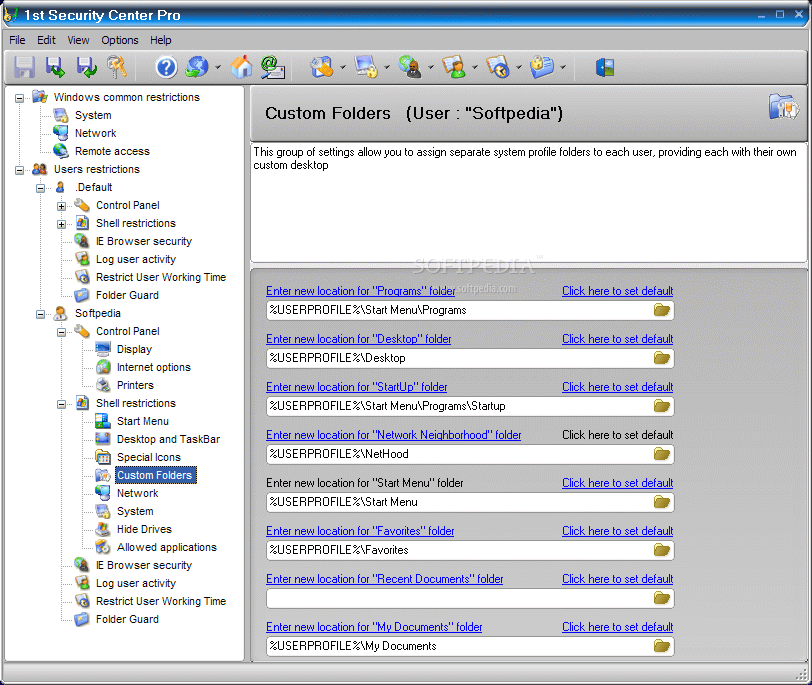
Here are some snapshots of the application in action:


Review imageReview imageReview imageReview image

IPv4 Goes IPv6

What is exactly an IP address? The term is the short for Internet Protocol Address and it is the logical address of a network adapter. IP corresponds to the network layer (layer 3) responsible


for end-to-end (source to destination) packet delivery. It works with TCP (Transmission Control Protocol) which deals with the transporting the packages. The term TCP/IP is used when referring to both of the protocols and makes possible network communications where TCP transport is used to deliver data across IP networks.

The concept is pretty easy to understand if you come to think of it. In order to communicate to another computer, you need an address (IP) and means of transportation of the data (TCP).

An IP address can be either private or public. Private addresses are assigned to computers in a LAN (Local Area Network) while public ones are used for the Internet or WAN (World Area Network). All the private IPs are communicating outside the local network through a public IP that is the gateway (the door to the Internet and WAN).

To make an idea on how important are IP addresses, you should know that network routers, web browsers, IM applications, mail clients rely on IP and other network protocols layered on top of the IP. This means that without an IP, there is not much to do. The IP technology started in the '70s and its purpose was to support the first research computer networks.

Nowadays, there are two IP technologies available. IPv4 is the version all home computer networks are currently using. Ipv4 consists of four bytes (32 bits) and for readability purposes, we work with addresses in a notation called dotted decimal. The range of addresses is from 0.0.0.0 to 255.255.255.255. This means that between each of the four numbers comprising the IP address, there will be a dot. The maximum number of IPs given by version 4 of the Internet Protocol is of 4,294,967,296 addresses. For some of you, it may seem large enough to cover today's requirements. However with the continuous expansion of network capabilities of all sorts of mobile devices, the demand will grow and v4 will become insufficient.

A couple of solutions have already been found for increasing the number of possible addresses. Developing IPv6 is one of them. The improved version will use 16 bytes addresses (132 bits) and this translates into an increased number of available IP addresses for the users. The total augmentation will reach 300,000,000,000,000,000,000,000,000,000,000,000,000. That should cover our needs for the next few years (the space is sufficient to cover 1030 addresses per person on the planet).

Another method also based on IPv6 is adding an extension of IPv4. This way, the IP address will consist of a combined notation (the last two bytes pairs in the right will be written in the normal IPv4 dotted decimal notation).

IPv6 or IP Next Generation (IPng) has several advantages compared to IPv4. Scalability is one of them (IPv6 has a 128-bit address while IPv4 has a 32-bit address). The next Generation Internet Protocol version comes with built-in security of the source). The “plug and play” mechanism featured by IPv6 eases the connection of equipment to a network, no manual configuration being needed or through DHCP servers.

The current solution adopted for extending the IP addresses is NAT (Network Address Translation). This is a networking protocol that allows LANs to be set up using a single public IP. It allows setting up a LAN with no special configuration of the Internet connection. Adopting this solution permanently is not too good of an idea as some peer-to peer applications will not work properly if NAT is being deployed in a network.

Also, multimedia applications (video conferences included, VoIP) cannot be used on NAT enabled devices as the protocols of these applications use UDP with dynamic allocation of ports and NAT does not provide the necessary support.

Addressing and routing hierarchy is also improved in the soon to be new IP standard. A larger address space allows allocation of larger address blocks to the ISPs (Internet Service Providers). This way, the ISP can aggregate the prefixes of all the customers into a single prefix and announce it to the IPv6 Internet.

NTT DoCoMo Achieves Data Transmission of Almost 5Gbps


Japan's leading mobile operator, NTT DoCoMo came close to hitting another data transmission milestone while researching the next-generation cellular phone systems during an experiment conducted last year, on December


the 25th in Yokosuka, Kanagawa Prefecture, Japan.

The company managed to transmit data at almost 5GBps to a receiver that was moving at 10km per hour, according to Yoshiki Kakuda, a spokesman for the Tokyo Company.

He also said that the company's public relations department didn't know the exact speed that was achieved, but that it was quite close to 5GBps. NTT DoCoMO has been working on the 4G technology for almost 10 years but they've still got a long way to go before it is launched.

The company is currently planning to launch 4G in Japan by 2010 but also indicated that it first plans to speed-up its WCDMA 3G network before switching to a new technology.

Approximately a year ago, NTT DoCoMo managed to transmit data at 2.5GBps, and this time they managed to double that by increasing the number of MIMO transmitting and receiving antennas from six to twelve and using better signal processing in the receiver.

As compared to the test in December 2005, the frequency spectrum efficiency was also doubled from 25bps/Hz to 50bps/Hz.The mobile operator also plans to launch a 'Super 3G' service by 2010 that will offer data transmission at approximately 100Mbps. NTT DoCoMO will present all the details on this recent experiment next week at the 3GSM World Congress in Barcelona.

The company has also announced that it is looking forward to contributing to the global standardization of 4G through its ongoing research and development.

Linux to power super-router

By Matthew Broersma, Techworld


A group of networking experts has launched a project designed to give Cisco's routers some open source competition.

The project, called the Open Linux Router, joins some other efforts at bringing open source into the world of routers, notably the Extensible Open Router Platform (XORP) sponsored by Vyatta, but aims to add features such as a file-sharing server and a firewall.

It is the brainchild of four Michigan university students, who acknowledged Vyatta as an inspiration but saw the need for a more expandable, easier-to-use system. The system, like XORP, is intended to run on off-the-shelf hardware, with enough modularity to allow it to run on anything from an embedded device to an enterprise server.

"These tools are wrapped up in such a way that the user does not need to know or fully understand their inner workings, only how to implement them," the developers said on the project's site.

Core to the project, announced late last month, is a simple interface that allows users to configure the device and add new features without extensive technical knowledge. One criticism of devices like the XORP or Asterisk's open source PBX is that the companies buying them don't necessarily have the technical knowledge to deal with maintenance.

While the Open Linux Router project is at an early stage, it is part of a growing interest in using open source to compete with companies such as Cisco in the realms of routers and PBXs.

For now, the movement is largely limited to small and midsize organizations and is focused around the Asterisk open-source private branch exchange and Vyatta open-source routers. Cisco and other old-time networking vendors certainly aren't yet shaking in their boots over it. But it's a growing movement that they ignore at their own peril; lower-cost, higher-function technologies have a way of replacing existing architecture far faster than vendors realize, open-source vendors say.

A tentative feature list for the Linux router includes SSL web interface, serial console, wireless support, VLAN support, packet filtering and other features. It is based on the Webmin configuration tool and initial code is available via Google Code.

The first substantial release of the project is scheduled for May or June, developers said.

Other Linux-based projects targeting firewall and network server include ClarkConnect, IPCop, m0n0wall, and Smoothwall.

Computerworld's Phillip Britt contributed to this report.

A New Approach to Mutating Malware

"CBC is reporting that researchers at the Penn State University have discovered a new method of fighting malware that better responds to mutations. From the article: 'The new system identifies a host computer with a high rate of homogeneous connection requests, and blocks the offending computer so no worm-infected packets of data can be sent from it.' This is a change from previous methods, which compared suspected viruses against known signatures. Mutations in malware took advantage of the time-delay between the initial infection and the time taken by the anti-virus system to update its known signatures. This new system claims to be able to recognize new infections nearly instantly, and to cancel the quarantine in case of false alarm."

Monday, February 05, 2007

Jakarta - Banjir - Januar Sudharsono

Mungkin anda akan berpikir “Mengapa Posting kali ini bejudul demikian?”. Tidak seperti biasanya saya menaruh artikel dan news tentang Komputer dan Dunianya, kali ini saya akan bercerita (lebih tepatnya Curahan Hati . red:Curahan Hati).


Mungkin anda telah banyak mendengar, membaca atau melihat berita sejak Jumat 2 Februari 2007 Jakarta kembali terendam dan banjir di berbagai wilayah. Banyak yang mengungkapkan hal ini sebagai siklus 5 tahunan Jakarta, dalam hal ini Ibukota NEGARA REPUBLIK INDONESIA.


Mengapa kali saya ingin curhat? Karena terhitung sejak Jumat 02 Februari 2007 saya bisa dikatakan mengelilingi, dan “belingsatan” dengan Jakarta dan Banjirnya. Baik kita mulai petualangan kita.


Jumat, 2 Februari 2007


Pukul. 08.00 WIB; Keluar kantor saya harus menjemput orang di Bekasi (tepatnya di daerah Kalimalang-Jatiwaringin). Perjalanan lancar terlebih lokasi kantor saya di Slipi, sehingga saya langsung masuk Tol Dalam Kota Jakarta dan Langsung meluncur menuju Cawang. Karena bensin mobil kurang memadai saya keluar di Pancoran untuk mengisi bensin. Terlihat kemacetan mulai terjadi disana sini akibat genangan air di beberapa lokasi. Setelah mengisi bensin kami langsung meluncur kembali dan masuk kembali ke Tol.


Tiba di Cawang mulai terjadi antrian yang tidak terlalu panjang karena hari hujan deras sekali dan tepat di bawah jembatan cawang air sudah tergenang. Terlihat di kiri dan kanan jembatan sebelum jalan menurun ke arah bawah jembatan cawang, daerah cawang dan UKI mulai terlihat banjir. Untung saja genangan air di bawah jembatan cawang saat itu belum terlalu tinggi sehingga kami dapat melintas (kebetulan saya menggunakan mobil kijang). Selepas tol cawang di dalam tol Jakarta-cikampek masih lancar dan tanpa hambatan (walau sedikit banyak melewati genangan air) kami pun dapat tiba di lokasi,kalimalang-jatiwaringin pukul 09.05 WIB.


Setelah tiba kami langsung berangkat kembali menuju jakarta karena harus tiba di Jakarta tepatnya di Hotel Millenium, Sirih-tanah abang pukul 10.00 WIB. Dalam perjalanan balik ini kami mengambil jalan lain untuk masuk ke dalam Tol Jakarta - Cikampek, tetapi kami harus memutar arah karena jalan yang kami tempuh ditutup karena banjir. Saat itu pula kami sudah melihat kemacetan yang terjadi di Jalan Tol Jakarta - Cikampek. Karena melihat hal tersebut kami memutuskan kembali ke jakarta tidak melalui tol. Kami mengambil jalan ke arah Kampung melayu, Pulo gadung.


Tanpa di sangka di tengah jalan terjadi kemacetan yang luar biasa karena ada bagian jalan yang terendam air karena melintasi kalimalang. Tidak hanya sampai disitu di bawah jalan layang untuk menuju ke pulo gadung jalan banyak ditutup baik ke arah kampung melayu maupun ke arah pulo gadung karena banjir. Kami pun memutar kembali ke arah jatiwaringin dan memutuskan untuk melewati tol jakarta - cikampek yang macet karena tidak ada alternatif jalan yang menjamin. Sebelum memasuki tol, kami terjebak macet kembali yang cukup lama dan panjang. Karena tidak menentunya keadaan dan hari yang mulai siang sekitar pukul 10.30 WIB kami menyempatkan beli makan “Bakwan Malang” yang panas karena dari pagi belum mengisi perut kami.


Akhirnya setelah perjuangan menyalib dan memotong banyak kendaraan di kala macet (hingga menyebabkan banyak pengemudi ngomel dan marah) kami dapat memasuki tol yang “macet” itu untuk menuju jakarta.


Tol padat dan macet sampai dengan Cawang karena di bawah tol Cawang ke arah tol dalam kota yang tadi di ceritakan di atas banjir sudah semakin tinggi. Dan hanya kendaraan besar dan tinggi yang dapat lewat. Sedangkan untuk ke arah tol Lingkar luar jakarta berhenti total karena banjir yang sudah terlalu tinggi. Saya memaksakan mobil untuk menembur banjir yang cukup membuat hati ketar ketir. AKhirnya kami dapat melewati banjir dan kemacetan di cawang serta masuk tol dalam kota jakarta yang lengang.


Lalu apa yang membuat kami tercengang adalah pada tol dalam kota untuk arah yang berlawanan dengan kami terlihat antrian mobil yang ‘berhenti’ karena tidak dapat melintasi banjir dan terjebak di dalam tol tersebut. Karena banjir pada arah yang berlawanan lebih dalam daripada yang kami tempuh, hal ini karena sungai berada tepat di sebelahnya. Yang lebih mengejutkan antrian kendaraan terjadi dari Cawang hingga setidaknya semanggi (karena saya hanya melintasi hingga semanggi untuk berbelok ke arah ke sudirman dan thamrind) dan tanpa adanya terlihat pergerakan sama sekali.


Kami sempat melihat di daerah mampang terjadi kemacetan karena di Gatot Subroto ada bagian jalan yang tertutup banjir. Pada saat melintasi sudirman kami melihat di daerah bendungan hilir terlihat banjir, walau jalan masih dapat dilewati saat itu. Begitu juga di depan Kampus UNIKA ATMAJAYA, kendaraan terlihat mengantri karena banjir.


Akhirnya kami tiba di Hotel Millenium Sirih-Tanah Abang tepat Pukul 14.13 WIB. Setelah tiba saya beristirahat karena lelah sepanjang hari menerobos kemacetan dan banjir.


Pada Sore harinya tepat pukul 17.00 WIB, kami harus pergi ke daerah kedoya - jakarta barat untuk mengambil beberapa dokumen. Kami mengambil jalan lewat Kawasan tomang, tetapi tepat di jembatan sebelum tomang kami terhalang oleh banjir dan terpaksa mengambil jalan lain. Lalu saya berbelok ke arah Roxy untuk memutar, kembali kami mengalami penutupan jalan karena banjir yang juga terjadi di daerah itu.


Akhirnya saya harus memutar arah kembali ke arah sirih untuk mengalihkan tujuan kami ke semanggi, tepatnya Plasa Semanggi dan BEJ. Saat tiba di Casablanca tepatnya di flyover Le Meridien terjadi kemacetan dan nyaris tidak bergerak. Lalu saya memutuskan untuk keluar dari kemacetan dan kembali ke jalan sudirman (untungnya belum sampai di atas jembatan). Karena waktu yang sempit kami membatalkan perjalanan dan kembali ke Hotel Millenium untuk hadir di acara berikutnya. Sebelumnya kami singgah di McD Sarinah untuk makan. Saat tiba di Hotel waktu sudah menunjukkan pukul 19.00 WIB.


Karena begitu pentingnya dokumen yang perlu di ambil di daerah kedoya dan BEJ serta membayar tagihan telepon selular di Plasa Semanggi, Saya kembali pergi, kali ini tidak menggunakan Mobil karena saya berpikir akan lebih aman dan praktis.


Dengan menggunakan ojek saya langsung meluncur ke arah plasa semanggi sebagai tujuan awal. Kami tertahan sedikit di Casablanca pada flyover le meridien (tapi karena keunggulan motor) saya dapat menembus kemacetan yang ada. Tak disangka di casablanca tepatnya sebelum mall ambasador juga tertahan karena tergenang air yang cukup tinggi sehingga banyak mobil terlihat mogok. Tanpa pikir panjang saya bersama tukang ojek mengangkat motor untuk menyeberang Pembatas jalan/ trotoar di tengah jalan untuk mengambil arah berlawanan, karena kami tidak dapat mencapai puteran yang tertutup banjir. Kami lalu melewati belakang Atma Jaya, apa yang saya temui adalah jalan benar2 terhenti karena dalamnya banjir yang terjadi di Daerah Atmajaya tersebut. Saya terpaksa berganti kendaraan untuk melintas banjir, kendaraan apa yang paling tepat? “gerobak” yah gerobak yang ditarik penduduk sekitar untuk menyebrangkan orang dan kendaraan roda dua.


Akhirnya saya dapat tiba di Plasa Semanggi dan langsung membayar tagihan telepon karena waktu sudah menunjukkan pukul 20.30 WIB. Sedangkan toko tutup pukul 21.00 WIB. Setelah selesai saya langsung bergegas berjalan ke arah BEJ untuk mengambil dokumen selanjutnya. Setibanya disana saya baru sadar saya tidak memiliki kode akses. Langsung saya beralih ke tujuan berikutnya …. Kedoya.


Dengan kesabaran menunggu kendaraan umum atau apa saja yang ada, di Halte Komdak bersama puluhan karyawan yang pulang kerja dan terjebak di antara kemacetan dan banjir jakarta. Akhirnya saya dapat bis untuk menuju ke arah slipi, itu juga bergelayutan di pinggir pintu yang hanya sebelah kaki dan tangan saja berada di dalam bis.


Sepanjang jalan dari semanggi sampai dengan Gedung DPR/MPR RI lancar, tetapi setelah itu keadaan berubah total dan terjadi kemacetan panjang. Akhirnya saya memutuskan berjalan kaki sampai dengan Slipi Jaya. Di Slipi Jaya saya kembali menggunakan ojek sebagai transportasi untuk menuju kedoya. Dengan melewati jalan di samping tol Kebon jeruk - Merak, keadaan jalan lancar dan lengang. Lalu apa yang saya saksikan saat melintas di atas jembatan untuk menyeberang ke sisi lain Tol, terlihat kemacetan yang panjang dan padat sehingga kendaraan total berhenti dan terjebak di dalam tol. Ada satu hal lagi yang menarik yang saya pun terkejut karenanya, Jalan tol jadi satu arah ke arah merah dari arah Tomang.


Setibanya di Apartemen Kedoya kembali terlihat kemacetan dan banyak juga mobil yang memutar arah. Saya harus meneruskan perjalanan karena lokasi yang saya tuju berada di belakang apartemen yaitu kompleks perumahan kedoya baru. Dengan berjalan kaki, perlahan tapi pasti saya tiba di depan kompleks Kedoya baru. Lalu apa yang saya temui, lautan air di seluruh kompleks, sehingga saya harus menembus dan ber’banjir’ ria. Karena cukup dalamnya air tidak ada kendaraan yang dapat melintas.


Setibanya di lokasi tujuan, langsung saya bergegas merapikan dokumen yang diperlukan. Tetapi sebelumnya saya menyempatkan diri untuk mandi karena begitu gatalnya badan akibat air banjir.


Setelah semua dokumen siap, saya pun berpakaian dan berkostum ala minimalis untuk bersiap kembali menembus banjir.


Sabtu, 3 Februari 2007


Waktu menunjukkan pukul 00.30 WIB saat aku meninggalkan lokasi. Tak enak sekali rasanya karena harus berbanjir ria kembali dalam keadaan badan yang bersih. Terlebih saat itu kembali turun hujan yang sangat deras dan lebat. Perjalanan dirasa semakin berat karena hari sudah malam dan badan sudah terasa lelah, ditambah lagi arus air yang lumayan kencang. “Apa itu ketus ku …. “ Ternyata ada truk yang ‘nekat’ menembus banjir, walau cukup tinggi tetap saja ban truk itu pun sudah tak terlihat karena ketinggian air sudah semakin bertambah. Yang aku kesalkan adalah karena truk itu gelombang air semakin terasa kencang dan bergejolak.


Akhirnya aku dapat tiba di daerah yang tak terkena banjir. Kulihat badan ku sudah basah karena banjir dan hujan deras yang menghujam bumi di tengah malam itu. Tampaknya payung yang ku gunakan sudah tidak berguna, langsung saja kucari kendaraan umum untuk melanjutkan perjalanan kembali ke hotel. ‘Ojek’ itu yang terlihat dan terlintas di kepala ku, karena begitu simple, cepat dan dapat di usahakan untuk segala keadaan.


Langsung saja ku tunggangi ojek itu, dengan nego harga tentunya. Akhirnya kami pun melaju, ‘Awas …. ‘ Teriakku karena jalanan di depan banjir. Langsung saja ojek itu spontan mengurangi lajunya. Tapi tampaknya kecepatan kami cukup tinggi sehingga akhirnya kami menabrak banjir dan mesin motor pun spontan mati karena busi basah terkena cipratan air. Tanpa pikir panjang daku turun dan mendorong motor ke tepian yang lebih tinggi agar mesin motor tidak terendam air. Patut dimaklumi juga karena malam itu gelap akibat listrik yang dipadamkan karena banjir ditambah lagi hujan lebat yang mengurangi jarak pandang.


Segera mungkin ‘tukang ojek’ itu mencari kain kering dan membuka busi motor dengan perlengkapan yang ada. Tidak lama kami pun sudah dapat berjalan kembali untuk mencapai tujuan, Hotel Millenium – Sirih. Dengan melalui jalan belakang slipi jaya, lalu terus langsung melintas kawasan jati baru dan berbelok ke arah thamrind. Tanpa terasa kami sudah tiba di Hotel Millenium pada pukul 01.00 WIB


Badan sudah terasa letih dan basah kuyup karena hujan lebat di tambah dinginnya udara saat itu. Tapi saya harus kembali bergegas kembali ke BEJ karena dokumen yang tadi belum diambil harus segera diambil untuk keperluan pagi harinya.


Berhenti sejenak menghisap sebatang rokok terasa begitu nikmat dengan badan yang basah dan lelah. Sehabis mengeringkan badan dan berganti pakaian di Parkir Basement Hotel Millenium, kami pun melanjutkan kembali perjalanan kami. Karena saya sudah tau keadaan jalan yang banjir, macet, dapat dilewati atau tidak maka kami pun tiba di BEJ pukul 02.00 WIB. Saat itu kami melewati jalan Jati Baru lalu memutar lewat slipi dan langsung lurus sepanjang jalan S. Parman menuju semanggi, Turun ke bawah semanggi dan langsung masuk Kawasan SCBD. Setelah beres dengan dokumen, kami pun bergegas kembali ke hotel.


Untuk jalan pulang kami mengambil jalan lain yang lebih cepat. Melewati jembatan semanggi lalu turun ke Jalan Sudirman lalu langsung terus menuju Thamrind, Sebenarnya di Sudirman terjadi kebanjiran yang mengakibatkan terperangkapnya mobil mulai dari depan Atma Jaya sampai dengan Jembatan Thamrind sebelum Bunderan HI. Tapi untuk arah berlawanan yang kami lewati jalan kosong dan lengang. Dan juga untuk jalur lambat di kawasan bendungan hilir. Kami hanya mengalami rintangan di depan Sarinah yang terjadi genangan yang cukup tinggi. Tetapi sekali lagi karena saya menggunakan kijang maka rintangan itu tak terasa begitu merepotkan.


Setibanya di Hotel kami pun segera istirahat karena sudah lelah dan mengantuk, tentu saja dengan membersihkan badan terlebih dahulu.

Launch of open source stack for mobile phones

Linux Mobile Phone Guy writes "Members of the open source GPE project (GPE Palmtop Environment) today announced a new offspring project to create a fully open source software stack for mobile phones, GPE Phone Edition. GPE Phone Edition is a fully open source project based on developments from the GPE project adding necessary components for mobile phone usage. Based on standards defined by the LiPS Forum a complete application software stack is built. The current implementation is based on code contributed to the LiPS Forum by Orange/France Telecom's research and development lab located in Beijing China in collaboration with GPE project members. The result is now an open sourced software stack which can handle a GSM compliant mobile modem for making voice calls, handling the SIM address book and sending and receiving SMS. Also some additional application exists e.g. for media playback, instant messaging and email. They have some screenshots there and even a downloadable VMware image using which you can try the whole thing in a virtual phone on your PC — if you connect a GSM Modem (like an existing phone) to /dev/GSM-Modem you should probably even be able to use the full phone functionality (access SIM card, send/receive SMS, make a call!)."

Black and White Twins

Meet my twin sister

A double take in black & white

A mixed-race British mom gave birth to twins recently - one of each. No, not a boy and a girl. Two girls - one black, the other white.

The odds of such a birth are about a million to one, experts said.

"It was a shock when I realized that my twins were two different colors," Kylie Hodgson, 19, told London's Daily Mail. "But it doesn't matter to us - they are just our two gorgeous little girls."

Hodgson and her partner, Remi Horder, 17, were both born to mixed-race parents.

Little Kian and Remee share a love of apples and the Teletubbies, their proud mom says.

Fertility experts speculate that a sperm containing all-white genes fused with an egg with all-white genes, and a sperm with all-black genes fused with an all-black gene egg to produce the fraternal twins.

Jose Martinez Pictures of Kian and Remee Hodgson, twin sisters born to a British couple who both had mixed-race parents Black and white twins born in England


Photos of black and white twin sisters and their parents, Kylie and Remi Hodgson

(Photo credit: Gary Roberts)

French schools swamped by books challenging evolution

This undated image received 30 November, 2004 from the University of Virginia shows Charles Darwin. Tens of thousands of French schools and universities have received copies of a Turkish book refuting Darwin's theory of evolution and describing it as

AFP/UVA-HO/File Photo: This undated image received 30 November, 2004 from the University of Virginia shows Charles Darwin....


PARIS (AFP) - Tens of thousands of French schools and universities have received copies of a Turkish book refuting Darwin's theory of evolution and describing it as "the true source of terrorism."


ADVERTISEMENT


The education ministry said Friday that it had warned school and university directors that the textbook is not in line with the recognized curriculum and that they should disregard it.

Entitled "The Atlas of Creation," the 770-page book by Turkish author Harun Yahya quotes several passages from the Koran and asserts that "human beings did not evolve (from another species) but were indeed created."

"We believe that there are lots of resources behind this campaign and the mass distribution, but were are not alarmed as the book has not reached the classrooms or documentation centers," said the education ministry.

The book features a photograph of the September 11, 2001 attacks on the World Trade Center with the caption: "Those who perpetuate terror in the world are in fact Darwinists. Darwinism is the only philosophy that values and incites conflict."

The theories of Charles Darwin are "the true source of terrorism," it said.

The books sent by post from Germany and Turkey began arriving in French schools and universities about 10 days ago.

The Figaro newspaper quotes an education official from Lyon as saying that this is not the first time that schools are swamped with controversial material.

The official said that the Church of Scientology had also embarked on a mass distribution of literature to schools a few years ago.